
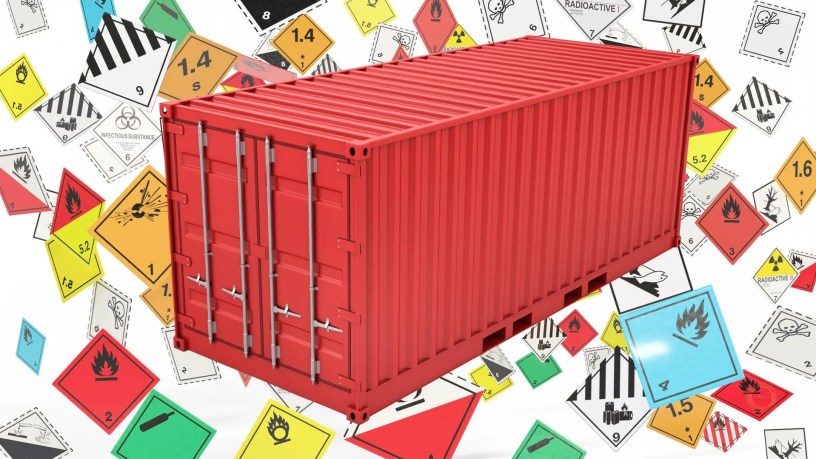
The marking and placarding requirements of the IMDG Code for cargo transport units containing packaged dangerous goods can be quite complex and deviate significantly to what you may be used to for road transportation using ADR.
These provisions can be found in the IMDG Code at Chapter 5.3.
We include detailed discussion of these provisions along with interactive exercises in our IMDG Code online training courses, available here.
We’ve summarised the main requirements below.
| Goods Marked/Labelled As | Placards (250x250mm) | Additional Placards | UN Number |
| UN class/division but no LQ | Yes, representative of the goods carried | If applicable for DGs marine pollutant & or fumigation or asphyxiation mark if applicable | If applicable under 5.3.2.1 (only one UN number carried & if > 4000 kg) |
| Packages of division 1.4S | None | Fumigation mark or asphyxiation mark if applicable | Not applicable |
| Packages displaying the Class 9 (model 9A) battery label | Class 9 placard (model 9 not 9A) | Fumigation or asphyxiation mark if applicable | If applicable under 5.3.2.1 (only one UN number carried & if > 4000 kg) |
| Batteries packed to the special provision 188 exemption | None | Fumigation or asphyxiation mark if applicable | Must not be displayed |
| Packages of limited quantities goods (and no other dangerous goods) | Limited quantities placard | Fumigation or asphyxiation mark if applicable. LQ goods should not be declared as marine pollutant | Must not be displayed |
| Mixed UN class/division & limited quantities goods | No LQ but placards for other goods | If applicable for DGs (not packed as LQ) marine pollutant & or fumigation or asphyxiation mark if applicable | Must not be displayed |
When required, placards should be fixed on both sides and both ends of a container or semi-trailer (IMDG 5.3.1.1.4.1.1). It is the responsibility of the loader to complete this and upon signing the packing certificate, you are confirming that this has been carried out satisfactorily.
Shipping lines prefer placards to be placed as high up as possible, in order that they are not obscured by any cradles or handling devices that may be used as part of the journey. The placards used and their affixing to the cargo transport unit must be such that they would survive 3 months’ immersion in the sea.
Particular attention should be paid to when UN numbers are required to be displayed and when they are not.
For example; the UN number should be displayed in digits at least 65 mm high for packaged dangerous goods loaded in a container or trailer, when this is the only dangerous goods present and the goods are in excess of 4000 kg gross mass.
If other dangerous goods are loaded, or if only one type of dangerous goods is loaded but it is not in excess of 4000 kg (4 tonnes) gross mass, then the UN number must not be displayed. In this second instance, placards which have a white space in which to write the UN number must also not be used.
Click on the link below to try our IMDG Code placarding quiz and test your knowledge!
 ★ EcoStar Blog ★