

Increasingly we are seeing a shift towards replacing the use of printed or hand written dangerous goods notes (DGNs) for road transport with the use of DGNs stored on electronic handheld devices.
ADR certainly allows for this, even with a cursory glance at the top of the first page of Chapter 5.4 (documentation) the provisions 5.4.0.2 and 5.4.0.3 allow for transport documents to be produced electronically and carried on devices such as tablets and phones.
The phrases used by ADR are electronic data processing (EDP) and electronic data interchange (EDI).
It’s easy to see the advantages of using an electronic device, no more collecting multiple pages of DGNs from consignors, new DGNs can be sent straight to the driver wirelessly, less scanning of paperwork or filing in folders when you get back to the office.
The key point that is repeated in ADR is that an electronic DGN must contain all of the information required by ADR 5.4 and in the sequence required by ADR 5.4.1.1.1.
The information on the tablet or device must also be as clear and accessible as if it was presented on a paper document.
If you are using electronic transport document you should be aware that UNECE has published official guidelines on what is considered equivalent to as clear and accessible as a paper document.
The full guidance can be found here:
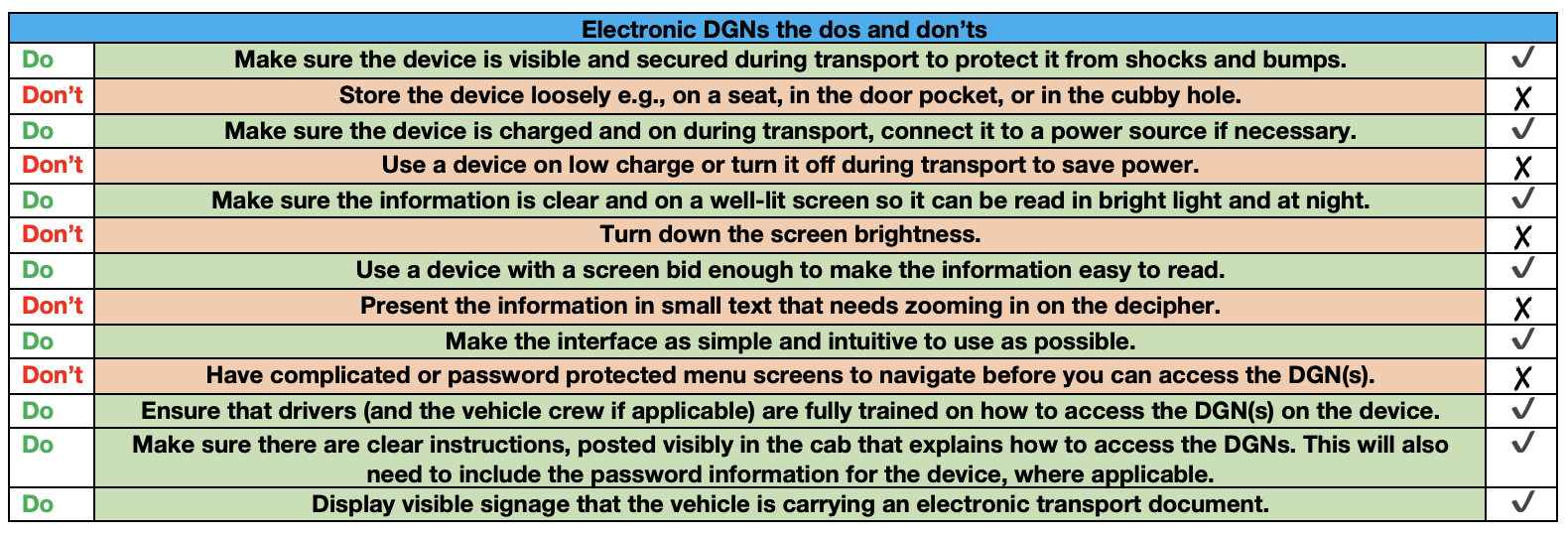
We’ve summarised some of the key points of these guidelines below.
- The electronic device which stores the DGN should be installed in a way that protects it against the normal stresses of transport.
- The battery of the device shall provide energy to the device for the duration of the transport, or be recharged during carriage.
- In different light conditions you must be able to read the data on the screen equivalent to reading the data off of a paper document.
- The minimum screen size of the device must be 10” for a .PDF or 3.5” for an “optimised screen” (like a phone or smaller tablet).
- Operation of the device shall be easy and intuitive to give inspectors/the emergency services unrestricted access to the dangerous goods information.
- The driver/s of the vehicles must be fully trained to access the dangerous goods information and be able to provide this to inspectors/the emergency services.
- Instructions must be displayed in the driver’s cab area on how to access the dangerous goods information if the driver is incapacitated.
- The front and back of the vehicle must be marked with a note indicating the use of an electronic transport document. In place of a note the mark pictured here may be displayed on both doors of the vehicles cab area.

- Like with all dangerous goods marks, the mark or note must be removed or covered when the vehicle is not carrying dangerous goods.
Whilst the guidelines are not legally binding, it is likely that failure to follow them would result in it being deemed that the electronic transport document in use is not equivalent to a paper document.
If you use electronic transport documents in your undertaking it is well worth considering the points above and reading the full UNECE advice publication.
 ★ EcoStar Blog ★